Concierge by Unicity Labs · white-label for operators
Concierge books, calls, and pays. Under your name, on your network.
A personal AI agent for every subscriber — proactive, permissioned, carrying your name. It surfaces the day before it's asked, calls the businesses that never built an app, and settles through the billing relationship you already have.
The product · activity stream
It doesn't wait to be asked.
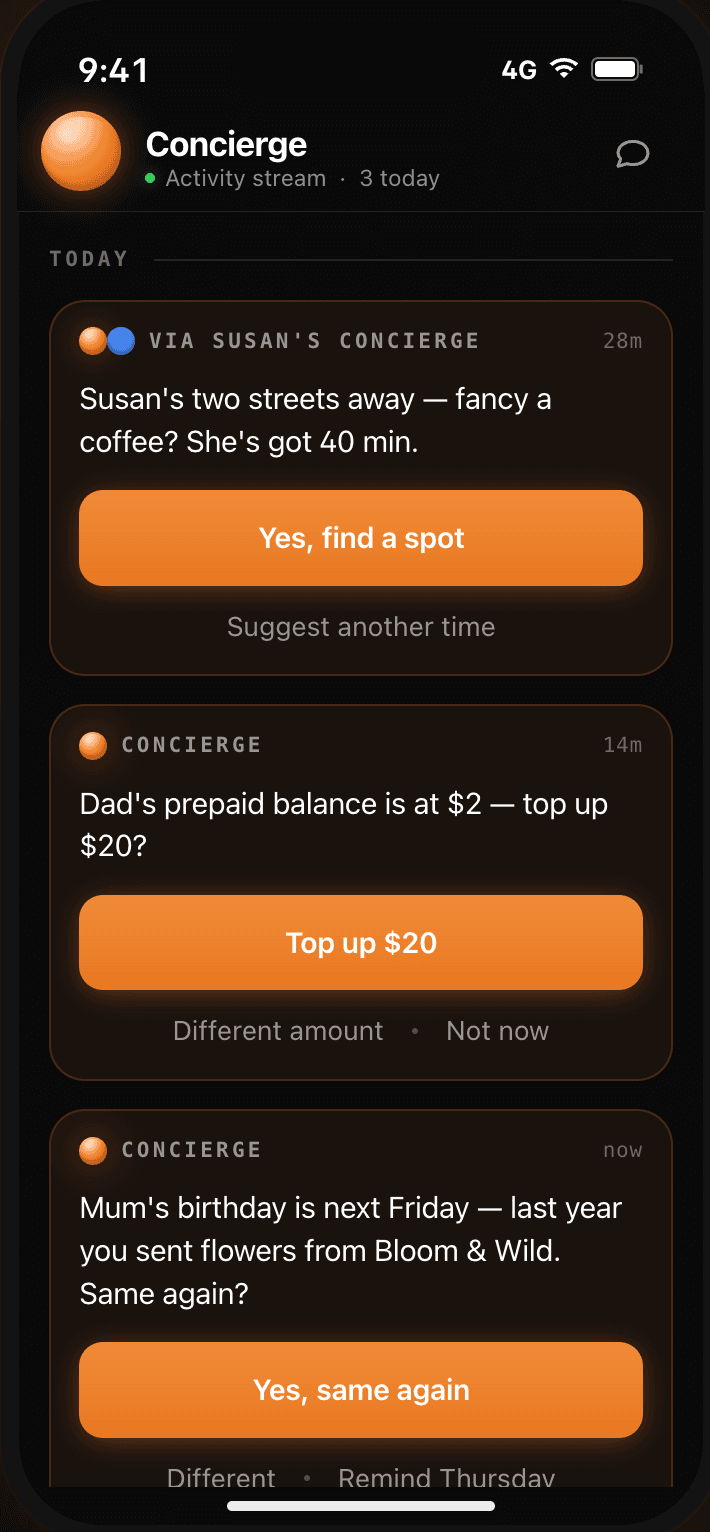
Not a chatbot — there's no prompt to write and no blank box to stare at. This is one subscriber's morning: three things the concierge noticed and brought forward on its own. Each one is a decision waiting for a tap.
Concierge
Activity stream ·1today
Susan's two streets away — fancy a coffee? She's got 40 min.
VIA SUSAN'S CONCIERGE · 28m
Susan's two streets away — fancy a coffee? She's got 40 min.
[Yes, find a spot] · Suggest another time — her concierge reached your subscriber's. Neither of them typed a word.
CONCIERGE · 14m
Dad's prepaid balance is at $2 — top up $20?
[Top up $20] · Different amount · Not now — it watches the family plan and moves first. That's your own airtime, sold without a campaign, a channel, or a retail margin.
CONCIERGE · NOW
Mum's birthday is next Friday — last year you sent flowers from Bloom & Wild. Same again?
[Yes, same again] · Different · Remind Thursday — it remembers last year. Same merchant, same basket, every year: recurring by construction.
THREE A DAY
A budget, not a target
Your CVM team is already fighting for room in the notification tray, and a campaign is a guess. These aren't campaigns — a top-up that was coming, a birthday already on the calendar. The agent spends its interruptions on things that were going to happen anyway.
The product · phone calls
Most businesses have no API. So it picks up the phone.
The florist, the clinic, the garage, the restaurant that still takes bookings by voice — the long tail of the real economy has nothing to integrate with. Concierge dials it, introduces itself as an AI, and finishes the booking while the subscriber gets on with their day.
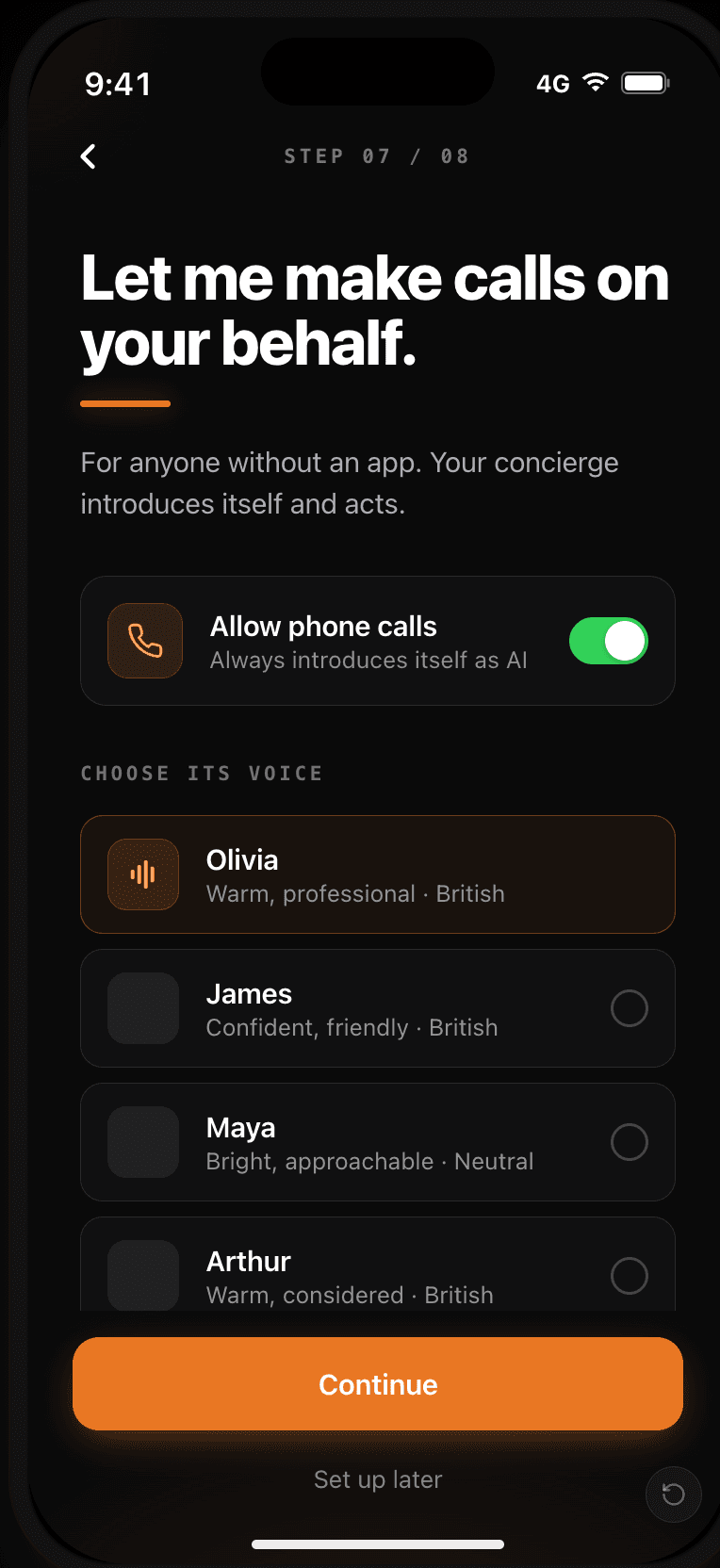
Always introduces itself as AI
Not a setting the subscriber can switch off — disclosure is wired into the call. You are never the operator that let an agent pretend to be a person.
A phone number is the integration
The businesses your subscribers actually use will never build you an API. They'll answer a call.
The subscriber picks the voice
Olivia, warm and professional. James, confident. Maya, bright. Arthur, considered. It's their concierge, in your app, under your brand.
It asks before it dials
Allow phone calls is an explicit toggle in onboarding — the subscriber sets it before the agent has a number to call. Permission is the first thing the product asks for and the only thing it won't route around.
Nova disputes a roaming fee and pays the bill — watch the transcript stream while it talks.
The product · agent-to-agent
Their agent picked up. Yours was already negotiating.
Your subscriber said cancel. The other end was a retention bot, not a person — so two agents did the haggling. Yours stopped once, at the only question that was the subscriber's to answer.
You told Nova to cancel StreamFlix ($89/mo). The provider's retention agent picked up first. Neither of them needs you for this part.
sound on · two agents talkingMachine speed, human authority
Agents settle what policy already decides — terms, floor, whether the offer clears it. The agent never moves the floor on its own; that pause is the product, not a limitation.
Cryptographic identity
Both ends got through because each could prove what it was; anything that can't, doesn't. Scoped, revocable, registered — that's the Agent Registry, not a trust setting.
Where it actually compounds
On your own base it compounds immediately: you issue both endpoints, so both sides are already registered and neither has to install anything to be reachable.
And if there's no agent on the other end? Then it calls them, and a person picks up. Agent-to-agent is the fast path, not the only one — which is why coverage never depends on which network the other party is on, or on a federation standard that doesn't exist yet.
The payoff · permission and payment
Dad has no card. That's a market, not a problem.
Nothing settles without a tap — every card is approve, modify, or decline, and the agent proposes rather than acts. But look at what the subscriber taps with. Dad is on prepaid. No card on file, no wallet, no checkout to abandon. Every agent that needs a card number is structurally locked out of him, at any price, forever. You are not.
Dad's prepaid balance is at $2 — top up $20?
Settlement ledger
You are the wallet
You're not competing for a slot in the subscriber's wallet. The subscriber has been paying you for years — that's the checkout, and there's nothing new to set up.
Not a feature. A line item.
The $20 top-up is your own product, resold by an agent that noticed. No campaign, no channel, no retail margin. That one is yours end to end.
The rest is a take rate — and we won't invent it
The coffee, the flowers, the booking: you're the identity, the authorisation, and the record, and your cut is whatever your merchant terms say it is. We're not printing a number for that on a marketing page. Bring your terms.
You've sold non-connectivity before
The last thing operators sold that wasn't connectivity was financial services, and it worked. This runs on the same asset — a billing relationship the subscriber already trusts, and an identity they didn't have to create.
Deployment · where it runs
This agent knows who your subscriber calls. It never leaves your boundary.
Agent activity and user data never leave your boundary. It knows who your subscriber meets, what they buy, who they call, and what they're worried about on a Tuesday afternoon. That is either an asset on your balance sheet or a training set on someone else's. The frameworks, the model, the sandbox, and the enforcement kernel all sit on your infrastructure — one gate, one egress, every action classified in-path.
Your environment
Frameworks
Internal LLM
Agent Registry
Cryptographic identity · scoped, revocable
AOS · Hosting Environment
Enforcement kernel · WASM sandbox · budgets
A2A networking + payments ↓
Semantic Intercept Fabric
One gate · single egress · allow / block / flag
sub-20ms overhead · the stall above is dramatised
External world
External LLM
Third-party model
Mobile App (hosted)
The subscriber's phone
External agent
Off-net counterpart
Semantic Intercept Fabric
Intent classified inline and policy enforced in-path at sub-20ms overhead. A rule engine catches known patterns, a detection model (load your own) catches anomalies, and a scanner finds secrets, IP, and personal data before it leaves.
Agent Registry
Cryptographic identity per agent — scoped, revocable, switched off from one place. The registry is why an agent from outside can be let in at all, and why letting it in is a decision rather than a hope.
AOS · Hosting Environment
Enforcement kernel, WASM sandbox, budgets. The agent runs inside the kernel — security can't be bypassed because there is no path around it, and every action lands in a tamper-evident record on its way through.
What hosting it actually costs you
Your GPUs, your SRE rota, your change board — we're not going to pretend otherwise. Capsule swap runs it air-gapped on local runtimes (Ollama, vLLM), and a caching capsule cuts 30–60% of API calls with the core code unchanged.
Why we're different
One agent is a demo. Forty million is an infrastructure problem.
Everything above is one subscriber's morning, and one subscriber proves nothing about a fleet. An agent on every line is an infrastructure problem long before it's a product problem. Unicity is a secure, efficient, and provable agent compute platform, built for telecom from day one — three levers bring the cost per agent down, and none of them is a slogan.
01 · Securely
Inside your kernel
The agent runs inside your kernel, on your infrastructure. Every action is intercepted in-path — security can't be bypassed, and data never leaves your network.
02 · Efficiently
A price that scales
Intelligent routing sends each task to the cheapest model that can handle it — checking a balance isn't reasoning — and multi-tenancy packs many agents onto the same hardware. A caching capsule stops you paying twice for the same answer.
03 · Provably
One definitive record
You don't infer what an agent did from scattered logs — every action lands in a tamper-evident record, one definitive, audit-ready answer for regulators and customers.
The number we won't print
Cost per agent, per month
This is the number the whole product lives or dies on, and the honest one depends on your traffic mix, your model policy, and what you already run. Any vendor who puts it on a web page is guessing at your workload. Bring yours and we'll build the model with you.
Routing · each task to the model that can do it
Small
Mid
Frontier
Multi-tenancy · many agents, shared hardware
One agent per box
density and routing · the ratio is your workload's, not ours
Get started
Own the agent layer before someone else does.
Every subscriber is about to get a personal AI agent. The only question left is whose name is on it. You've seen the subscriber's screen — the demo is the other half.
Or reach us directly